Shopping Cart



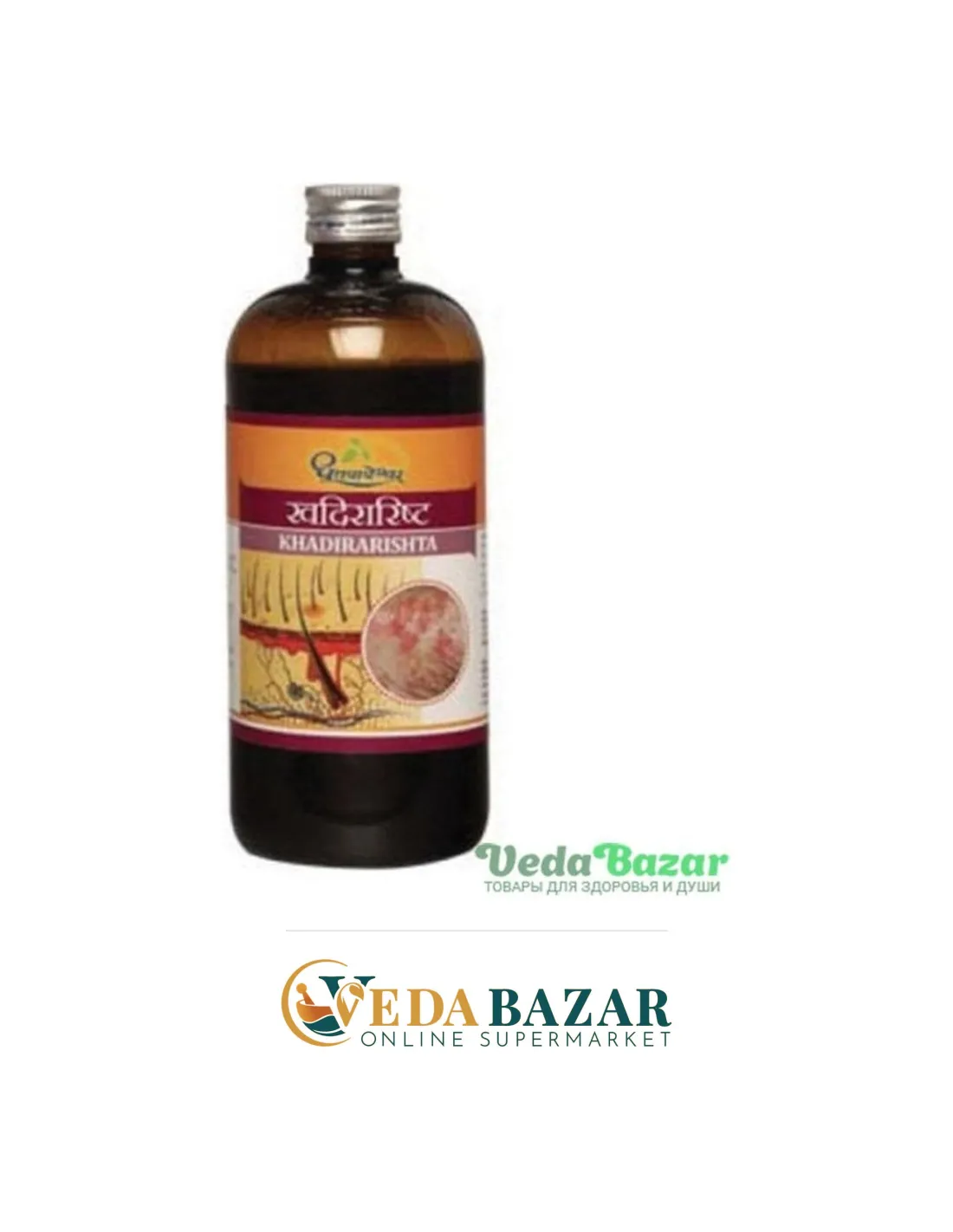
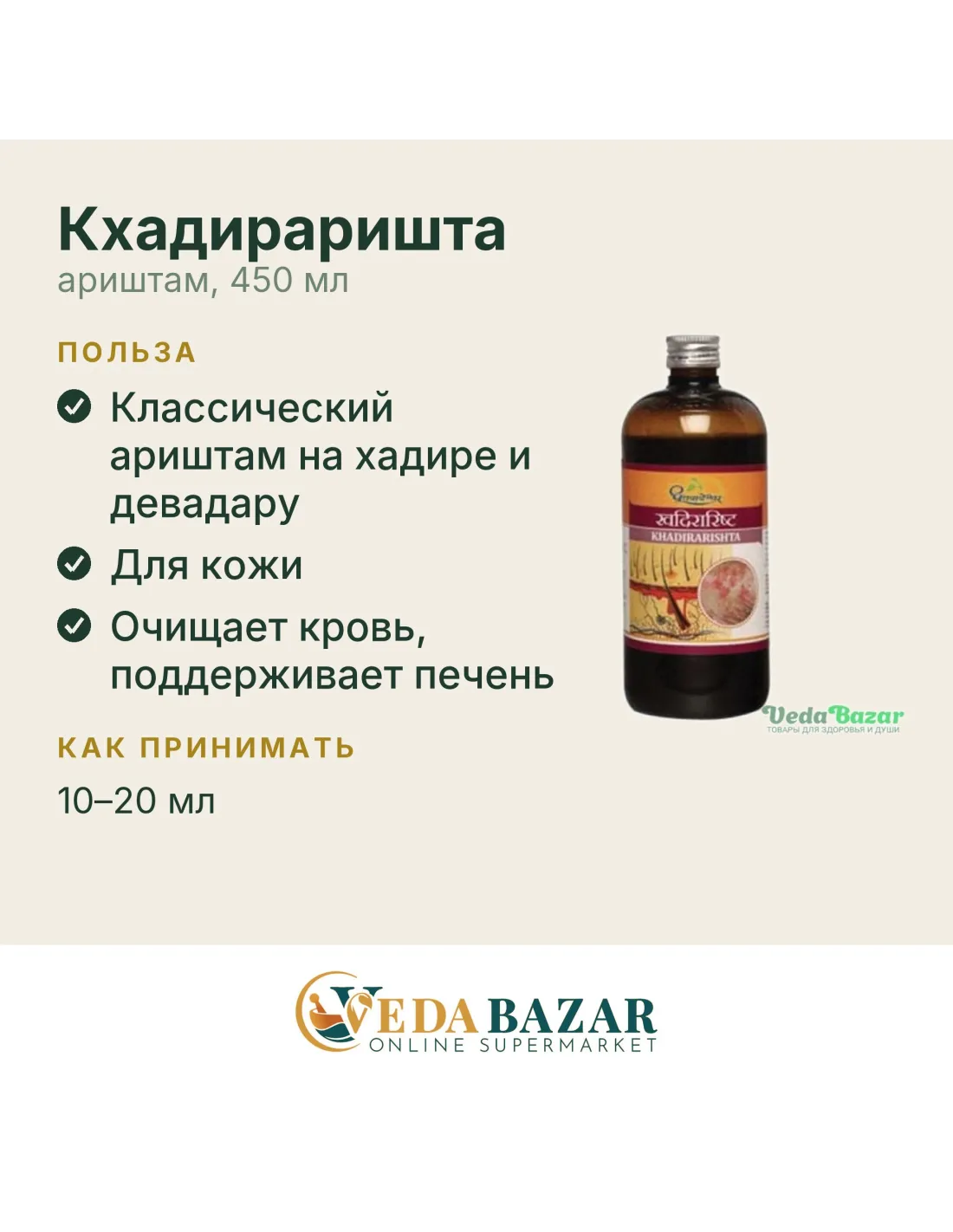
Khadirarishta, arishtam, 450 ml

in stock
₽780.00
Tax included
Clear skin and blood
· A classical arishta on khadira and devadaru
· For the skin
· Cleanses the blood, supports the liver
· Supports immunity
· 450 ml
What is Khadirarishta?
Khadirarishta is a classical fermented formula long valued for skin disorders (kushtha). According to the manufacturer it is traditionally used in vicharchika, ekakushtha and pama, and by the classics also for parasites (krumi), nodules (granthi) and pandu (anaemia).
The tonic cleanses the body deeply and reduces inflammation, cleanses the blood and helps the liver – and through it the skin and the cardiovascular system. It is prescribed for skin conditions, impaired liver function, anaemia, weakened immunity, difficulty digesting food, throat conditions (colds, hoarseness), accumulated waste and inflammatory processes. The tonic is famous in India and abroad; the formula is made strictly by ancient recipes. Like all arishtas it contains a little natural alcohol formed during fermentation, which helps the herbs to be absorbed better.
In Ayurveda it is bitter and astringent with a slightly warming action. Khadira and devadaru reduce Kapha and Pitta – inflammation, itching, wet skin – while honey and sugar help the herbs to be absorbed.
Key ingredients
Khadira (catechu, Acacia catechu) – astringent, wound-healing, antiseptic; traditionally for the skin, gums, throat and voice.
Devadaru (Cedrus deodara) – Himalayan cedar: a strong antibacterial, for the skin and joints.
Bakuchi (Psoralea corylifolia) – a natural tonic, traditionally for the skin (vitiligo), hair, heart and urinary tract.
Daruharidra (Berberis aristata) – bitter barberry: for the liver and skin.
Dhataki (Woodfordia fruticosa) – starts fermentation; for the female system, inflammation and wounds.
Triphala (haritaki, bibhitaki, amalaki) – gently cleanses, supports digestion and immunity.
Honey and cane sugar – nourish, aid healing and make the herbs digestible.
Who is it for?
Skin: rashes, itching, inflammation, cleansing is needed
Blood and liver: cleansing support is needed
Immunity: weakening, frequent colds
Throat: hoarseness, colds
Pitta and Kapha: heat, dampness, stagnation
«The skin is the mirror of the liver and blood»
Effect on the doshas
 Vata neutral |
 Pitta calmed: cools inflammation |
 Kapha reduced: clears dampness and stagnation |
How to take
As prescribed by an Ayurvedic doctor. Per the manufacturer: 10–20 ml (2–4 teaspoons) twice a day with an equal amount of lukewarm water; our earlier description gives 1–2 tablespoons twice a day.
If you are pregnant, breastfeeding, have a chronic condition or take medication – talk to your doctor first.
Contraindications: if you are planning conception, be careful: according to our description the remedy may have a mild contraceptive effect.
Why we chose Dhootapapeshwar
Sadly, many Ayurvedic products in India are made from poor raw material. That is why Vedabazar works only with trusted makers. Shree Dhootapapeshwar was founded in 1872 by the Ayurvedic physician Krushnashastri Puranik (company data) – one of the oldest Ayurvedic companies in India; classical formulas follow the Ayurvedic texts strictly.
Product details
| Quantity | 450 ml |
| Form | arishtam |
| Maker | Shree Dhootapapeshwar, India |
| Storage | in a cool dry place |
This information is for reference only and does not replace medical advice.
- Need
- Skin and hair
dh0040
26 Items
Shipping from India – EMS, courier to your door
- We pack and ship your order within 7 working days and email you the tracking number – it is also in your account. Rare and made-to-order products may take longer – check the time when placing the order.
- Delivery takes 2–3 weeks on average, depending on customs and the post in your country.
- The EMS courier brings the parcel to your home and calls in advance – please add your phone number.
- Shipping is calculated by order weight and shown in the cart: from 1 420 ₽ for a parcel up to 250 g. The bigger the order, the cheaper each 100 g of shipping.
- If there is no EMS service in your country, the parcel is delivered by your national post.
- Up to 5 kg in one parcel.
More about shipping and customs · Questions – message us on Telegram
Per 10 ml (maker data):
| Khadira (Acacia catechu) | 1.085 g |
| Devadaru (Cedrus deodara) | 1.085 g |
| Bakuchi (Psoralea corylifolia) | 0.260 g |
| Daruharidra (Berberis aristata) | 0.434 g |
| Haritaki (Terminalia chebula) | 0.434 g |
| Bibhitaka (Terminalia bellirica) | 0.434 g |
| Amalaki (Emblica officinalis) | 0.434 g |
| Dhataki (Woodfordia fruticosa) | 0.434 g |
| Kankola (Piper cubeba) | 0.022 g |
| Nagakeshar (Mesua ferrea) | 0.022 g |
| Jatiphala (nutmeg) (Myristica fragrans) | 0.022 g |
| Lavanga (clove) (Syzygium aromaticum) | 0.022 g |
| Ela (cardamom) (Elettaria cardamomum) | 0.022 g |
| Tvak (cinnamon) (Cinnamomum verum) | 0.022 g |
| Tvakpatra (Cinnamomum tamala) | 0.022 g |
| Pippali (Piper longum) | 0.087 g |
| Honey (madhu) (–) | 4.340 g |
| Cane sugar (sharkara) (Saccharum officinarum) | 2.170 g |
Comments (0)
No customer reviews for the moment.
Tap to zoom