Shopping Cart



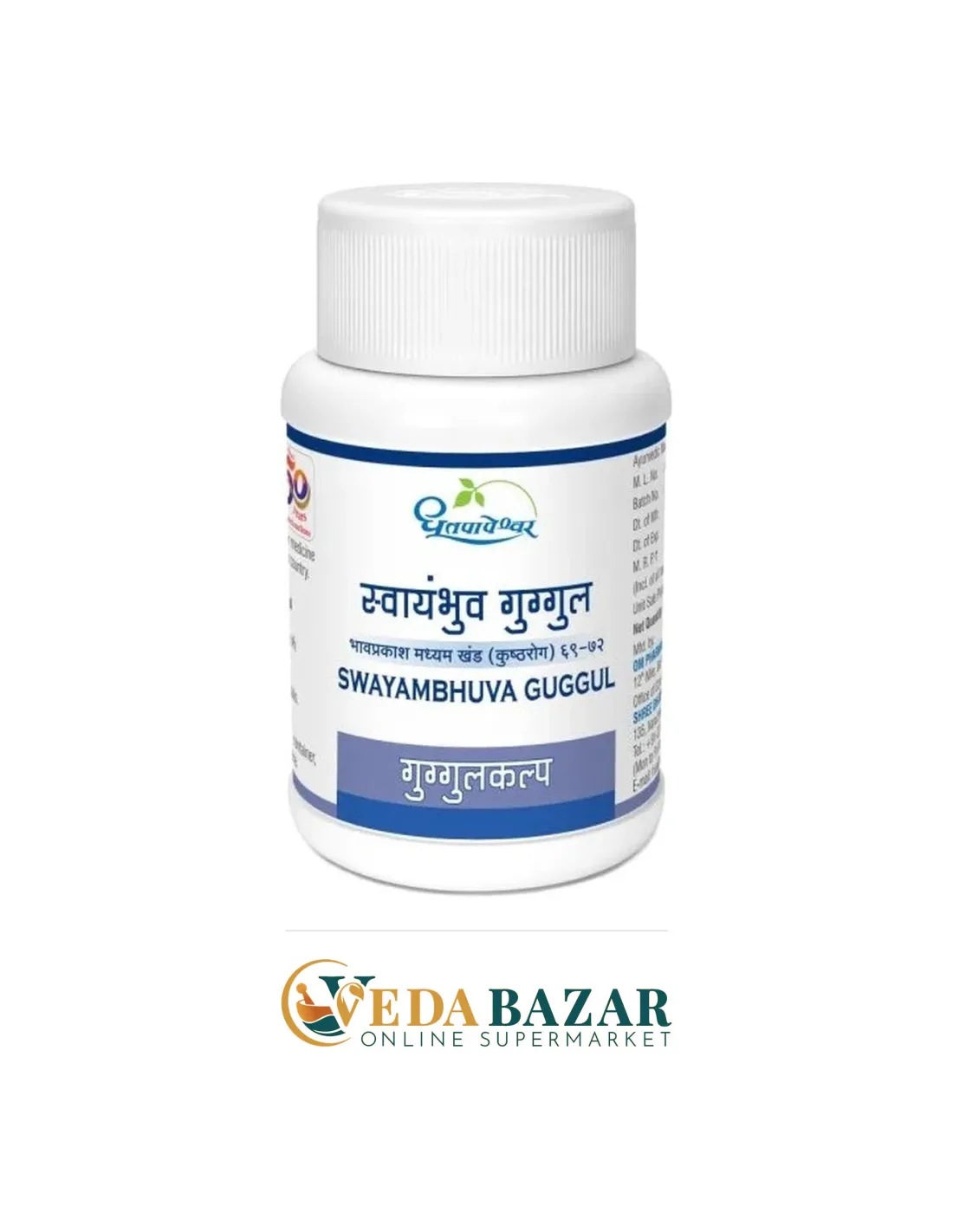
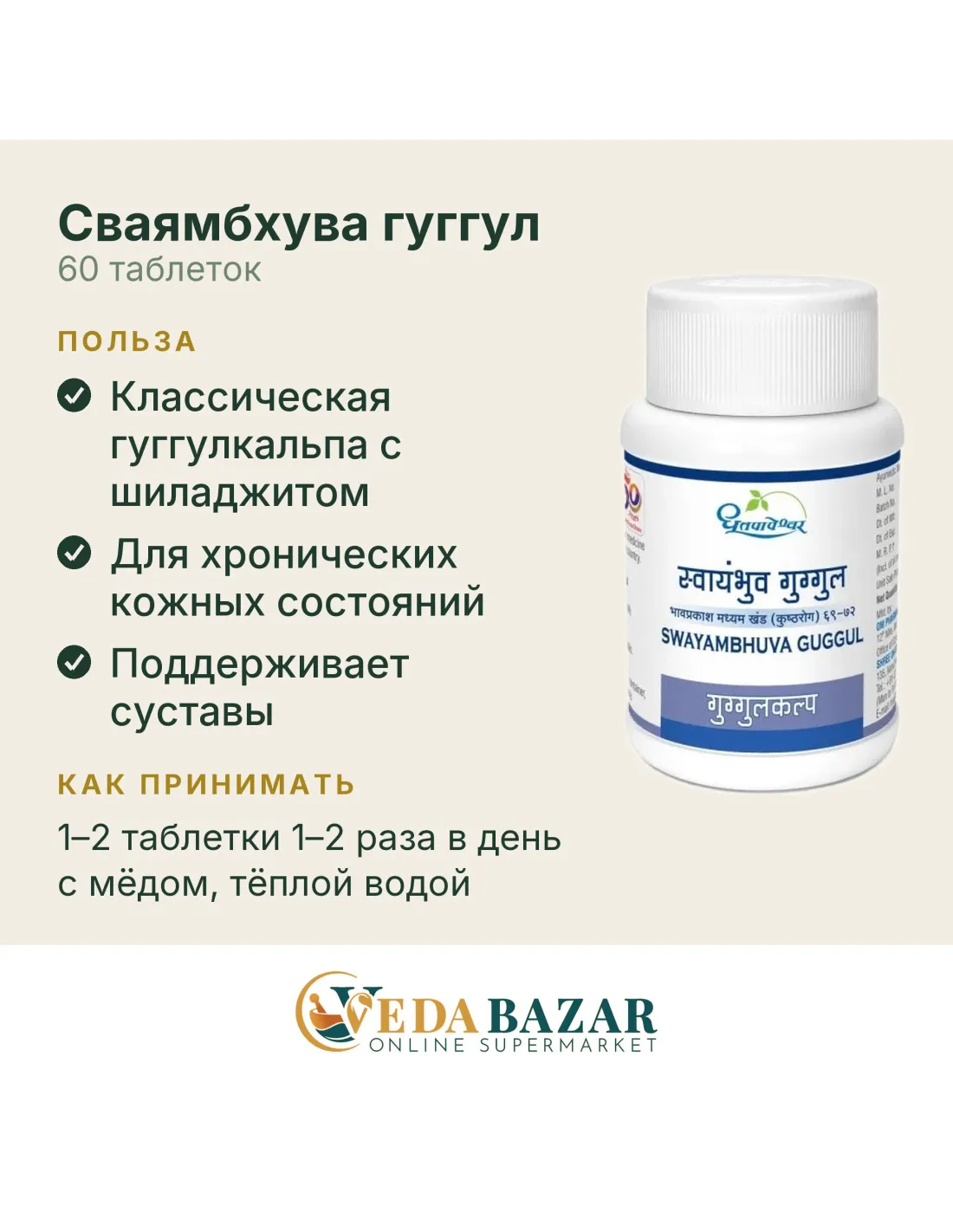
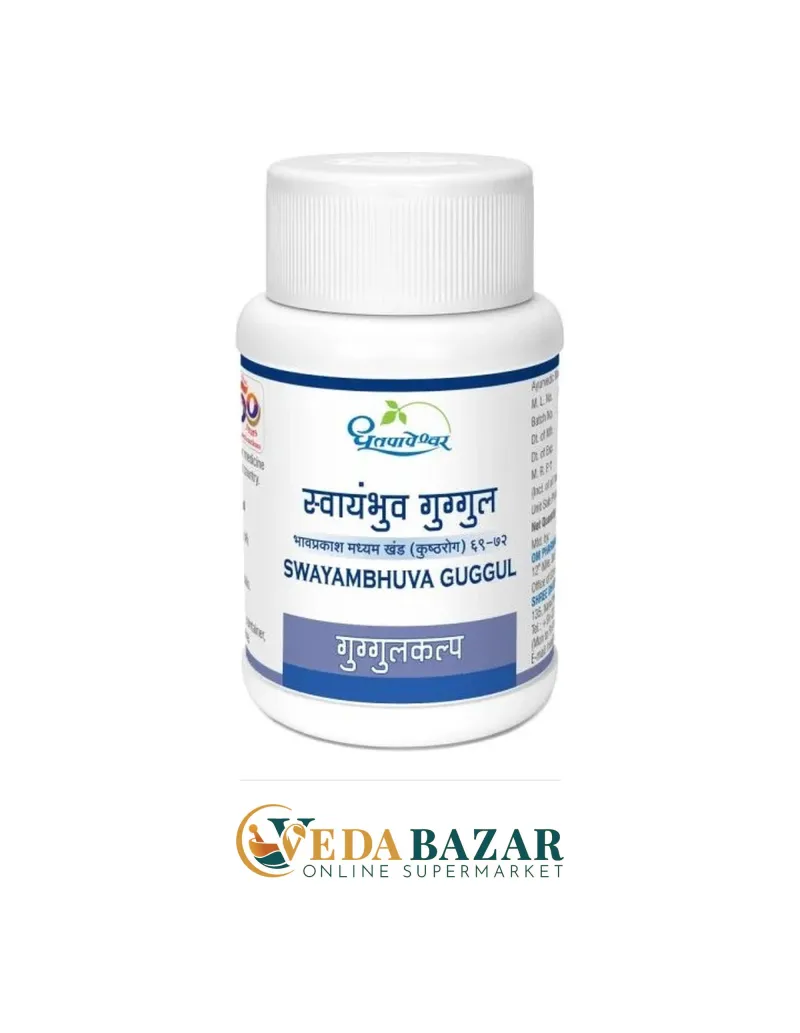
Swayambhuva Guggul, 60 tablets

in stock
₽590.00
Tax included
Skin, joints, blood
· A classical guggulkalpa with shilajit
· For chronic skin conditions
· Supports joints, tendons and ligaments
· Cleanses blood, supports the liver
· 60 tablets
What is Swayambhuva Guggul?
Swayambhuva Guggul is a classical guggulkalpa: purified guggul resin, shilajit, bhasmas (suvarnamakshika and loha), bakuchi and about twenty herbs – neem, turmeric, guduchi, haritaki and others. The manufacturer describes it for Vata and common skin conditions.
According to our description it rejuvenates the skin and connective tissue – joints, tendons, ligaments – helps with aches and body pains, supports the liver and blood (including anaemia), and improves the skin in acne, eczema, psoriasis, leucoderma and itching. It is also traditionally used for type 2 diabetes, gout, ascites, early liver changes, grey hair and wrinkles.
In Ayurveda it is a bitter, astringent and pungent warming blend; it cleanses blood and skin, balances Pitta and Kapha, while guggul resin nourishes Vata. Taken as prescribed by an Ayurvedic doctor. It is made by Dhootapapeshwar – a company with over 125 years of history making remedies by the canons of Ayurveda.
Key ingredients
Shilajit – a mineral-organic complex: supports strength and absorption, nourishes tissues.
Guggul (Commiphora wightii) – cleanses; supports metabolism, joints and cholesterol; strengthens the herbs.
Bhasmas: suvarnamakshika and loha – classical Rasashastra: iron and pyrite for blood, skin and strength.
Guduchi (Tinospora cordifolia) – an immunomodulator and adaptogen; cools heat; supports joints.
Neem (Azadirachta indica) – a bitter cleanser of blood and skin, especially for Pitta and Kapha.
Turmeric (Curcuma longa) and khadira (Acacia catechu) – turmeric is anti-inflammatory and wound healing; khadira is astringent, for skin and gums.
Who is it for?
Skin: acne, eczema, psoriasis, itching
Joints and ligaments: aches, stiffness, gout
Blood and liver: need cleansing support
Vata: body pains, fatigue
Type 2 diabetes: as part of complex support prescribed by a doctor
Ageing: grey hair, wrinkles, dry skin
«Skin is the mirror of the blood»
Effect on the doshas
 Vata calmed: nourishes and warms |
 Pitta calmed: cleanses with bitterness |
 Kapha reduced: clears stagnation |
How to take
As prescribed by an Ayurvedic doctor. Usually: 1–2 tablets 1–2 times a day with honey or warm water (traditionally also with gomutra). In a Pitta type too large a dose may bring heat or gas – keep to the doctor’s dose.
If you are pregnant, breastfeeding, have a chronic condition or take medication – talk to your doctor first.
Contraindications: Better avoided in pregnancy and breastfeeding. For children over 5 – only in very small doses.
Why we chose Dhootapapeshwar
Sadly, many Ayurvedic products in India are made from poor raw material. That is why Vedabazar works only with trusted makers. Shree Dhootapapeshwar was founded in 1872 by the Ayurvedic physician Krushnashastri Puranik (company data) – one of the oldest Ayurvedic companies in India; classical formulas follow the Ayurvedic texts strictly.
Product details
| Quantity | 60 tablets |
| Form | tablets |
| Maker | Shree Dhootapapeshwar, India |
| Storage | in a cool dry place |
This information is for reference only and does not replace medical advice.
- Need
- Joints and bones
Skin and hair - Dosha
- Kapha
Pitta
dh0009
268 Items
Shipping from India – EMS, courier to your door
- We pack and ship your order within 7 working days and email you the tracking number – it is also in your account. Rare and made-to-order products may take longer – check the time when placing the order.
- Delivery takes 2–3 weeks on average, depending on customs and the post in your country.
- The EMS courier brings the parcel to your home and calls in advance – please add your phone number.
- Shipping is calculated by order weight and shown in the cart: from 1 420 ₽ for a parcel up to 250 g. The bigger the order, the cheaper each 100 g of shipping.
- If there is no EMS service in your country, the parcel is delivered by your national post.
- Up to 5 kg in one parcel.
More about shipping and customs · Questions – message us on Telegram
Each tablet contains:
| Purified shilajit (shodhit shilajatu) (–) | 29.762 mg |
| Purified guggul (gomutra shodhit) (Commiphora wightii) | 59.524 mg |
| Suvarnamakshik bhasma (–) | 17.857 mg |
| Loha bhasma (–) | 11.905 mg |
| Bakuchi (fruit) (Psoralea corylifolia) | 29.762 mg |
| Munditika (flower) (Sphaeranthus indicus) | 11.905 mg |
| Haritaki (Terminalia chebula) | 5.952 mg |
| Bibhitaki (Terminalia belerica) | 5.952 mg |
| Amalaki (amla) (Emblica officinalis) | 5.952 mg |
| Karanja (leaf) (Pongamia pinnata) | 5.952 mg |
| Khadira (heartwood) (Acacia catechu) | 5.952 mg |
| Guduchi (stem) (Tinospora cordifolia) | 5.952 mg |
| Trivrut (root) (Ipomoea turpethum) | 5.952 mg |
| Danti (root) (Baliospermum montanum) | 5.952 mg |
| Musta (rhizome) (Cyperus rotundus) | 5.952 mg |
| Vidanga (fruit) (Embelia ribes) | 5.952 mg |
| Haridra (turmeric) (Curcuma longa) | 5.952 mg |
| Kutaja (bark) (Holarrhena antidysenterica) | 5.952 mg |
| Nimba (neem bark) (Azadirachta indica) | 5.952 mg |
| Chitraka (root) (Plumbago zeylanica) | 5.952 mg |
| Aragvadha (fruit pulp) (Cassia fistula) | 5.952 mg |
Preservatives: sodium benzoate, sodium methyl paraben, sodium propyl paraben.
Comments (0)
No customer reviews for the moment.
Tap to zoom